By: Denise Valdez-Alvarez
OMAHA, Neb., – A new linguistics lab at the University of Nebraska at Omaha is creating opportunities for students and making an impact in the Omaha community.
The Sociolinguistics and Language Structures Lab (SoLaS) was created to analyze how social factors shape language patterns throughout Omaha communities.
The lab’s current study, English in Omaha, examines how Omaha residents speak English.
Little research has been conducted on Midwestern accents, with people often thinking they do not have an accent or that they speak “normal” English, said Azumi Kuchma, a research assistant at the SoLaS lab and a UNO student.
“There’s so much research on the coast, so we know exactly what like a Boston accent versus like an LA accent looks like. But then because everyone [is] just kinda like ‘Oh whatever it’s the midwestern accent, there is no accent,’ they’re glossing over so many different nuances in each area,” Kuchma said.
Kuchma joined the lab in May 2025 after hearing about the opportunity in her English accents class. She started as a volunteer and then as an intern to gain experience working in the linguistics field.
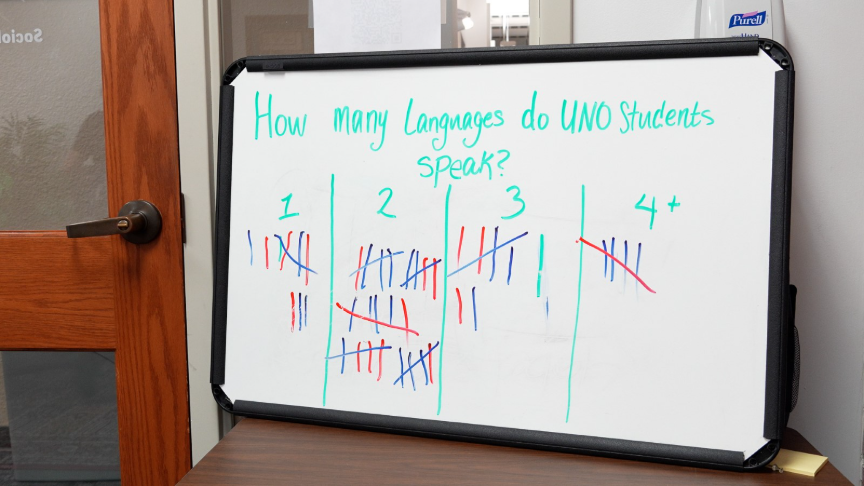
On Oct. 7, Kuchma and the SoLaS lab team set up a table outside the Milo Bail Student Center, where they asked people passing by how many languages they speak. Of the 49 people who responded, 39 said they spoke more than one language. The results were based on people who stopped by the table.
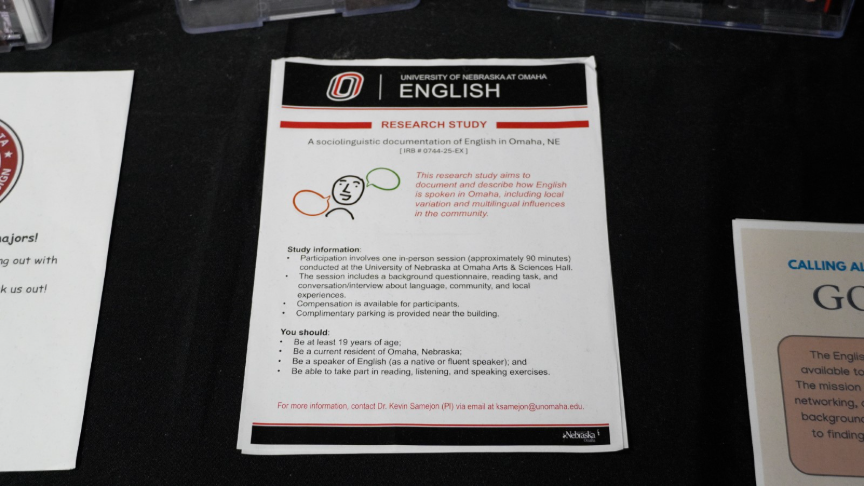
Some questions in the English in Omaha study ask participants about their linguistic and social backgrounds, language usage, opinions, experiences and perceptions of language in Omaha.
According to the University of Richmond’s Mapping Inequality interactive maps, redlining divided Omaha communities along racial and ethnic lines.
Before moving to Omaha, Kevin Samejon, director of the lab, examined the city’s demographic distribution to better understand his new home.
Samejon said concentrated communities develop distinct linguistic patterns through interactions among community members, reflecting their culture and heritage. Those patterns can also influence people’s attitudes toward language.
“There’s definitely like grey areas and we’re, the work that we’re doing is interested in both. Like those who are densely connected to their communities and those who are in the fringes and how they negotiate their identities and ways of speaking in that kind of environment and context,” Samejon said.
Kuchma said the study has helped participants recognize that Nebraska’s linguistic patterns are just as important as those in New York or Los Angeles.
“I’m hoping to see a day where it’s not all just condensed into the Midwest because the Midwest is such a grand region. We take up so much space here in the Midwest and it’s such a shame that there’s so little research done thus far, so that’s our goal here,” Kuchma said.
The lab is encouraging Omaha community members, especially families, to participate in the study.
Participants must be at least 19-years-old, live in Omaha and be fluent in English. Free parking is available, and participants receive compensation at the end of the interview.
“If they’re part of communities that are not well represented, here in the city or holistically, I would definitely urge them to like help us help them understand the way they use the languages that they speak, and their experiences in Omaha at the moment as they reside here,” Samejon said.
For more information about the Sociolinguistics and Language Structures Lab or how to participate in the study, visit SoLaS Lab Research | Department of English | University of Nebraska at Omaha or call (402)554-3636 for questions.